Moon
Meeus, Astronomical Algorithms · checked against USNO
Preview
The test data isn't published yet; the work is in issue #6. The case count, the expiry date and everything under Test data are made up to show how the finished page will look.
Planned · 4 cases · valid until 2027-12-31
What it is
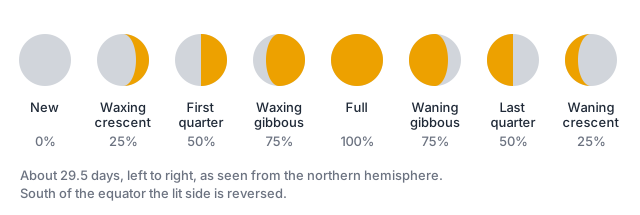
The moon goes around the Earth about every 29.5 days, lit by the sun from a different angle each night. Illumination is the fraction of its face that’s lit, and the phase names where it is in the cycle. It’s close enough that where you stand shifts where you see it, so its rise and set need a correction the sun doesn’t.
- It rises about 50 minutes later each day, so about once a month a day has no moonrise, and another has no moonset.
- Waxing is growing, waning is shrinking. The lit side is on the right while it waxes, seen from the northern hemisphere.
- It builds on astronomical time, like the sun.
Operations
| Operation | Gives |
|---|---|
events |
Rise, set and transit in a windowIn: latitudeInDegrees, longitudeInDegrees, startUtc, windowInHoursOut: riseUtc, setUtc, transitUtc, isAlwaysUp, isAlwaysDown |
phase |
How much is lit, and the phase's name, at an instantIn: instantUtcOut: illuminationFraction, phaseAngleInDegrees, phaseName |
nextPhases |
The next of each of the four main phases after an instantIn: startUtcOut: newMoonUtc, firstQuarterUtc, fullMoonUtc, lastQuarterUtc |
Fields
| Field | Meaning |
|---|---|
latitudeInDegrees | −90 to 90, WGS84, north positive |
longitudeInDegrees | −180 to 180, WGS84, east positive |
startUtc | The window's start, ISO 8601 in UTC |
windowInHours | The window's length, 24 unless a case says otherwise |
isAlwaysUp | true when it's above the horizon for the whole window |
isAlwaysDown | true when it's below the horizon for the whole window |
instantUtc | An instant, ISO 8601 in UTC |
riseUtc | The top of the moon reaches the horizon, with parallax. null if it doesn't happen in the window |
setUtc | As rise, going down |
transitUtc | Highest in the sky |
illuminationFraction | 0 to 1, the part of the face that's lit |
phaseAngleInDegrees | 0 at full to 180 at new |
phaseName | new, waxingCrescent, firstQuarter, waxingGibbous, full, waningGibbous, lastQuarter or waningCrescent |
newMoonUtc | The next new moon |
firstQuarterUtc | The next first quarter |
fullMoonUtc | The next full moon |
lastQuarterUtc | The next last quarter |
Edge cases
| Case | What's right |
|---|---|
| A day with no moonrise | riseUtc null, not the next day’s |
| Above the Arctic Circle | Days when the moon never crosses the horizon: isAlwaysUp or isAlwaysDown |
| Exactly at a phase | phaseName is that phase, not its neighbour |
For agents
Follow Meeus, Astronomical Algorithms: chapter 47 for position, 48 for illumination and 49 for the phase dates. Correct for the moon’s parallax and semi-diameter when finding rise and set; its altitude at rise changes with its distance. Find events in the window from startUtc. Pass every case in vectors.json within its tolerance.
Test data
In vectors.json, published 2026-01-01. Earth model: WGS84. How to read it: Test data format.
| Field | Tolerance |
|---|---|
riseUtc | ± 120 s |
setUtc | ± 120 s |
transitUtc | ± 120 s |
newMoonUtc | ± 120 s |
firstQuarterUtc | ± 120 s |
fullMoonUtc | ± 120 s |
lastQuarterUtc | ± 120 s |
illuminationFraction | ± 0.01 |
phaseAngleInDegrees | ± 0.5 |
Every other field is compared exactly.
| Case | Input | Expected |
|---|---|---|
placeholder-1events · reference |
latitudeInDegrees 11.11longitudeInDegrees 22.22startUtc "2026-01-01T00:00:00Z"windowInHours 24 |
riseUtc "2026-01-01T03:21:00Z"setUtc "2026-01-01T15:43:00Z" |
placeholder-2events · edge |
latitudeInDegrees 11.11longitudeInDegrees 22.22startUtc "2026-01-02T00:00:00Z"windowInHours 24 |
riseUtc nullsetUtc "2026-01-02T16:30:00Z" |
placeholder-3phase · reference |
instantUtc "2026-01-01T00:00:00Z" |
illuminationFraction 0.12phaseName "waxingCrescent" |
placeholder-4nextPhases · reference |
startUtc "2026-01-01T00:00:00Z" |
firstQuarterUtc "2026-01-02T12:34:00Z"fullMoonUtc "2026-01-09T12:34:00Z" |
Implementations
| Repo | Status |
|---|---|
| gshaw/algorithms-swiftSwift | Incomplete |
Each is a public repo that runs this page's test data with mise run test. See how implementations work.
Source
| Method | Astronomical Algorithms, 2nd edition, 1998Jean Meeus |
| Reference | Astronomical Applications APIUS Naval Observatory · Public domain |